Science desk
Tirzepatide dose targets and the missing comparison with a longer early phase
A treatment strategy includes its sequence, duration and rules for change. This analysis explains how to test a claim about staying at an early dose without reading an unstudied strategy into a target-dose graph.
Published · 11 minute read
A claim about remaining at an early tirzepatide dose is a claim about a treatment strategy. Assessing it requires more than finding a familiar amount in a study. The scientific question is whether the proposed sequence, time spent at each stage and outcomes of interest correspond to an intervention that was actually compared. Our interpretation begins with that distinction: an amount names one feature of treatment; a regimen specifies a path through time.
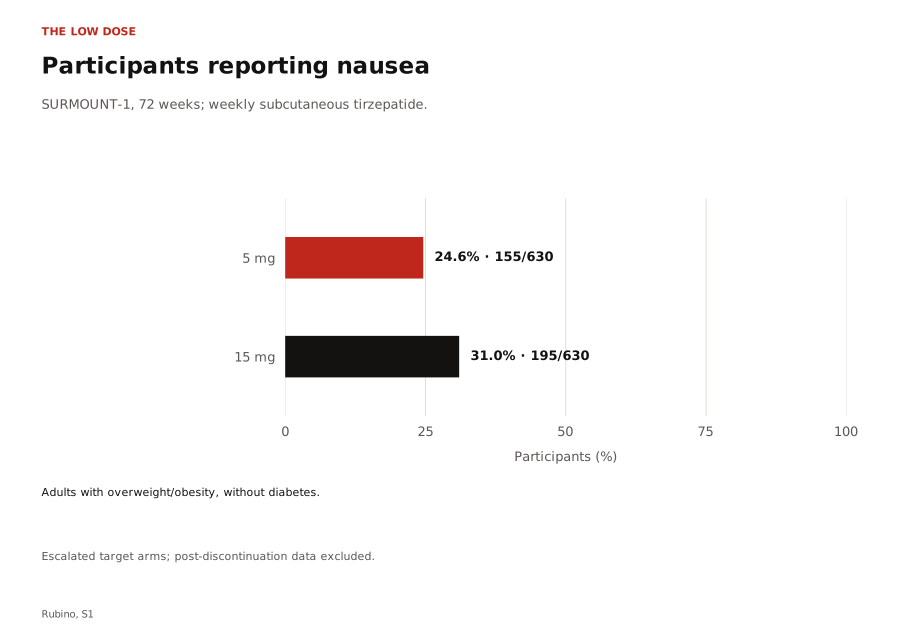
The chart provides a concrete starting point for reading such evidence. The discussion below develops the questions needed to move from a plotted comparison to a different proposed strategy. It does not calculate a result for an omitted regimen. Nor does an unanswered question establish that a smaller-dose approach always succeeds or always fails. A useful assessment identifies the missing comparison precisely enough that evidence could resolve it.
Wide tables can scroll horizontally. Keyboard users can focus a table region and use the arrow keys to move across it.
Reading the evidence
- Intervention identity
- Ask whether the whole proposed strategy matches the strategy being evaluated.
Sources: [2]
- Grouping rule
- Separate an assigned plan from a group defined later by what participants tolerated.
Sources: [2]
- Observation boundary
- Specify which part of an experience belongs inside the outcome being summarized.
Sources: [2]
- Unmeasured outcome
- A symptom measure cannot substitute for a separate measurement of benefit.
Sources: [2]
- Missing comparison
- Define the alternative regimen before asking what evidence supports it.
Sources: [2]
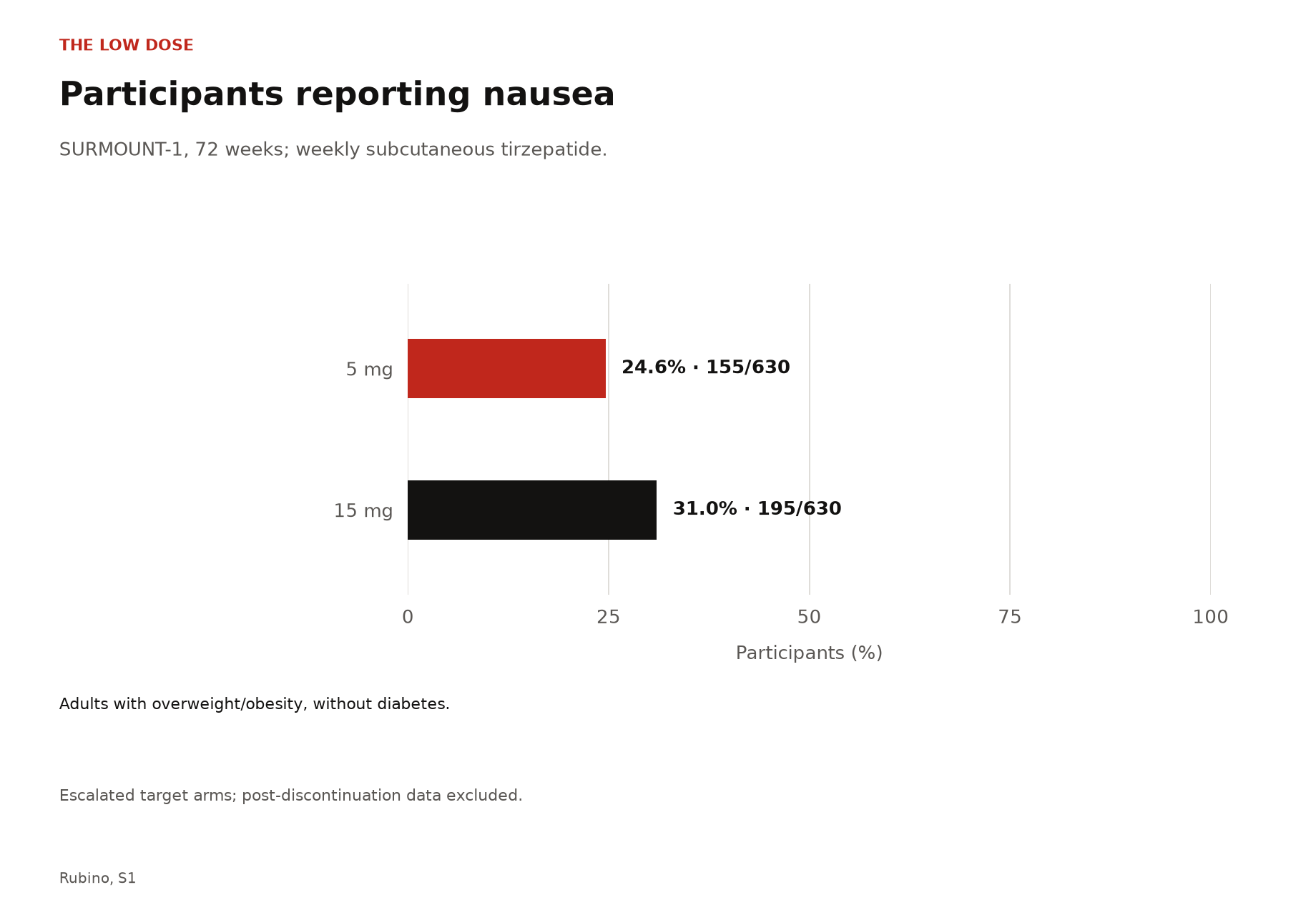
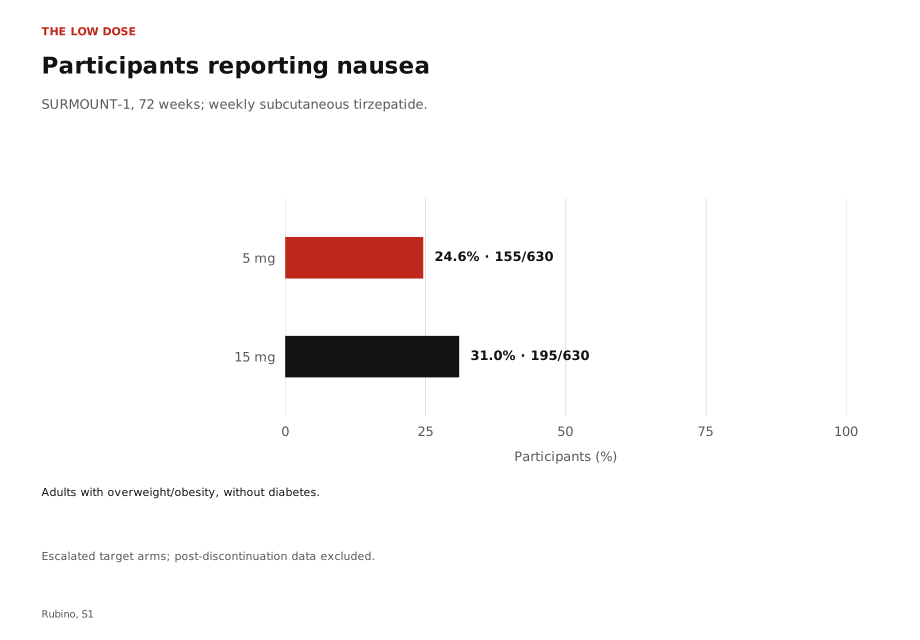
Participants reporting nausea
SURMOUNT-1, 72 weeks; weekly subcutaneous tirzepatide.
Adults with overweight/obesity, without diabetes.
Escalated target arms; post-discontinuation data excluded.
Sources: [2]
| Target | n/N | Percent |
|---|---|---|
| 5 mg | 155/630 | 24.6% |
| 15 mg | 195/630 | 31.0% |
A target names only part of an intervention
Rubino’s post hoc analyses examined escalating regimens; Lilly funded the report, and six authors were employees and shareholders.
The methodological issue is what it would mean to reproduce a strategy. A description needs an entry condition, a sequence, rules for transitions and an observation period. If one description supplies only a destination while another specifies remaining at an earlier stage, they do not yet describe the same intervention. Shared ingredients in their descriptions cannot establish equivalence between the complete plans. This is a question of definition before it is a question of whether either plan produces a desirable result.
A useful reading exercise is to write the proposed comparison as a sentence: among a defined group, compare following one specified path with following another, and measure a specified outcome over an agreed interval. Any blank reveals information needed to interpret the claim. The guide to reading a prescription is a separate reading destination for treatment documentation. Here, the scientific purpose of identifying the path is to prevent a result from changing meaning merely because a shorter description sounds familiar.
Sources: [2]
The time spent at a stage changes the question
Consider two proposed strategies that share an initial component but differ in when, or whether, they move beyond it. Their similarity at entry does not tell us their similarity later. Holding a stage longer changes exposure over time; it also changes the period during which an outcome could be recorded under that stage. To compare the strategies fairly, the question must define both paths and give each an appropriate observation window. This reasoning does not predict which path would perform better.
The design problem becomes clearer when time is written into the intervention rather than placed only on the chart axis. “Remain there” and “pass through there” are different instructions for a hypothetical study, even when they name the same amount. A proposed comparison would need rules for departures from each plan as well as a definition of successful follow-up. The titration guide offers another reading destination; it should not replace those research definitions. A claim about extending a phase needs evidence about that extension, not merely evidence that the phase appears somewhere within a longer sequence.
Sources: [2]
An endpoint is a question with a counting rule
An endpoint is the outcome a study chooses to measure. Its counting rule determines the question answered by a percentage. A proportion of people with a qualifying experience differs from a count of recurring episodes, a duration of discomfort or a judgment about seriousness. The same collection of experiences could be summarized in several ways, and each summary would preserve some information while discarding other information. Precision about the question therefore matters before the reader compares the sizes of bars.
For example, a yes-or-no indicator gives the same qualifying status to anyone who crosses its definition, regardless of how many additional episodes follow. That logical property does not reveal whether repetition was common in any particular study. It explains why recurrence cannot be recovered from an indicator alone. Similarly, absence of the selected outcome is not a complete inventory of health, and its presence is not a measurement of treatment benefit. Reading an endpoint narrowly preserves its usefulness: the result can answer its own question without becoming a substitute answer to every other question a reader cares about.
Sources: [2]
Assignment and achieved exposure describe different groups
There is a methodological difference between grouping people by the plan they entered and regrouping them later by what they actually received. The first rule classifies people before their later experience is known. The second can incorporate events that happen during follow-up. If a later experience influences both the amount received and the outcome being studied, a comparison of achieved amounts may mix the effect of the strategy with the reasons people reached those amounts. This is a potential selection problem, not an assertion that a particular pattern occurred here.
To interpret either approach, ask what question the grouping rule is intended to answer. Assignment can address the consequences of adopting a plan, while an exposure question asks about treatment received under specified conditions. Moving between them requires additional assumptions and information. The companion semaglutide analysis provides another setting for practicing this distinction. A label attached to a group should never be silently rewritten as an identical exposure history for every member. The distinction also prevents a person who tolerated a path from being treated as evidence about everyone who might start it.
A smooth line would be an additional model
A graph can tempt a reader to imagine a continuous curve connecting its categories. That curve would be a model: a proposed relationship extending beyond the displayed observations. Its appearance could be made smooth without making its assumptions true. Before using such a model, one would need reasons for its shape, a definition of the outcome it predicts and evidence that it applies to the intended population and treatment strategy. The visual convenience of a line supplies none of those requirements.
Interpolation means estimating between observed values; extrapolation extends beyond them. Neither operation is justified simply because a dose has a numerical scale. In particular, replacing one amount in a strategy can also change time at that amount, transitions and subsequent exposure. A model based only on the amount would leave those features unstated. The table sets out original methodological questions for proposed changes. It does not rank the alternatives or imply that research on them cannot exist. Its purpose is to distinguish a claim that needs its own evidence from a result already represented by a specific comparison.
| Proposed change | Comparison to define | Information needed |
|---|---|---|
| Extend an early phase | A longer phase versus a specified alternative | Transition rules and aligned observation periods |
| Choose a different target | Complete paths leading to each target | How exposure and departures are recorded |
| Apply the result elsewhere | The intended population versus the studied setting | Eligibility and conditions relevant to transfer |
| Predict an omitted strategy | The proposed strategy versus a credible comparator | Direct observations or a justified model |
Sources: [2]
An analysis boundary is part of the result
A summary has a boundary around the observations it includes. If observations after a particular event are outside that boundary, the summary cannot automatically describe everything that happens afterward. This is a logical limit of the question being asked, not proof that the analysis is defective. A restricted period may answer a useful question. The difficulty arises when the answer is presented as though it covered a broader period without checking what additional information that broader claim requires.
Changing the boundary also requires deciding how to handle people whose observation ends at different times. Missing later values do not reveal their own direction: they cannot simply be assumed favorable, unfavorable or unchanged. A credible extension would explain how those values were obtained or what assumptions replace them. The discussion of stopping a GLP-1 is a separate reading destination for questions about treatment transitions. For research interpretation, distinguish the event that changes treatment from the event that ends observation. Conflating the two can make a limited summary appear to answer a question about the entire subsequent course.
Sources: [2]
Elapsed time does not identify the phase that mattered
A cumulative outcome answers whether an event occurred within a defined interval. It does not, by itself, locate the event within a treatment sequence. To study a particular phase, a researcher would need dates or other timing information that connect exposure and outcome. Dividing an overall proportion by the length of follow-up would not reconstruct that connection. Such division would create a new quantity with assumptions about timing that the original proportion does not supply.
A phase-specific question also needs an appropriate starting point. Comparing experiences from the beginning of a plan differs from comparing experiences only after reaching a later stage. The latter question concerns people who reached that stage under whatever selection process preceded it. Neither starting point is inherently the answer to every question. The useful step is to define the question before selecting the clock. For an extended early-phase strategy, that would mean specifying when comparison begins, which experiences count and how later changes are handled. Without that structure, time spent at a stage and total time in a study can be mistaken for interchangeable measurements.
Sources: [2]
Symptoms and benefit need separate measurements
A symptom cannot function as proof of benefit merely because both might occur during treatment. To make that inference, one would need evidence connecting the measurements under a clearly defined question. Likewise, absence of a symptom cannot establish absence of benefit. These conclusions concern the logic of measurement, not an estimate of a clinical relationship. A symptom indicator and a benefit outcome can each be informative while answering different questions about the same strategy.
The distinction becomes especially important when people are divided into groups according to an experience that occurs after treatment begins. Such groups may differ for reasons related to exposure, follow-up or other characteristics. An observed association would not alone identify which feature caused another. A stronger investigation would state the causal question, establish the order of measurements and explain the assumptions needed to separate competing explanations. Until those steps are addressed, a tolerability display should not be turned into an overall benefit-risk ranking. Choosing an outcome that is easy to notice does not make it a validated substitute for the outcome one ultimately wants to understand.
Sources: [2]
Keep a commercial description separate from a research claim
Our editorial interpretation is to assess the scientific question and the commercial description separately. A named amount in an offer does not define an evaluated treatment strategy, and a clear contract does not establish a clinical outcome. The Healis review is a destination for checking documentary terms, without implying that the provider reproduces a studied intervention. The twelve-month cost guide addresses a different reading task. Neither a price nor a billing interval fills a missing comparison in a scientific analysis.
The same separation helps when examining how a claim is worded. Ask whether the claim names an outcome, a population, a complete regimen and an observation period. If one element is missing, request that definition before treating the claim as testable. The guide to evaluating a seller is another document-checking destination. These links do not establish anything about a provider’s product, eligibility decisions or outcomes. The table translates broad statements into research questions so that a reader can identify what evidence would actually resolve the uncertainty, rather than substituting an attractive description for a defined comparison.
| Proposed inference | Missing comparison | Useful observation |
|---|---|---|
| A quieter experience implies equal benefit | Both outcomes under defined alternative strategies | Benefit and symptom measurements collected together |
| An early phase predicts indefinite use | Extended use versus an explicit comparator | Follow-up appropriate to the longer strategy |
| A group result predicts one person’s course | Relevant individual prediction under stated conditions | Validated prediction with uncertainty |
| A named amount identifies the intervention | Full sequences and rules for changing treatment | A complete description of both strategies |
Sources: [2]
Prescribing information answers a different safety question
Zepbound’s current prescribing information contraindicates use with personal or family medullary thyroid carcinoma, MEN2, or serious hypersensitivity to tirzepatide or any ingredient. The boxed warning reflects rodent thyroid tumors; relevance to humans remains unknown. Warnings address pancreatitis, gallbladder disease, dehydration-related kidney injury and severe digestive reactions. Severe gastroparesis makes use not recommended. Obtain prompt assessment for severe or persistent abdominal pain; discuss persistent digestive symptoms with a clinician. Tell the anesthesia team about treatment. Graphs cannot prescribe dose changes.
The methodological distinction is between describing a group comparison and deciding how treatment should be managed. A chart summarizes a selected outcome under defined conditions. An individual decision also requires clinical information that is not represented by a bar or its label. Even a correctly read scientific comparison does not contain an automatic instruction for changing a regimen. Treating the absence of such an instruction as a limitation of the decision tool is more accurate than asking the graph to perform a task it was not designed to perform.
For a future study of an alternative strategy, safety would need explicit outcome definitions and follow-up alongside any proposed benefit. The design should state what would count as a useful improvement and what tradeoffs remain important. That makes the research question assessable without declaring an unmeasured alternative superior. A well-defined question is the starting point for evidence, rather than a reason to improvise treatment from a visual comparison.
Questions about the evidence
What would count as evidence for staying at an early dose longer?
Evidence would need to address a defined extended-phase strategy and an explicit alternative, with outcomes and follow-up appropriate to the claim. A shared amount alone is insufficient to identify that comparison. This describes what the research question requires; it does not assert that every possible smaller-dose strategy has been studied or that none has. The answer depends on the particular strategy and outcome being proposed.
Sources: [2]
Can an unplotted regimen be estimated by extending the bars?
That would introduce a predictive model rather than recover an observation. The model would need justified assumptions about the relationship between regimen and outcome, including timing and the intended population. A visually plausible extension does not establish those assumptions. No such estimate is calculated here, and uncertainty about an omitted regimen should remain explicit until suitable evidence addresses it.
Sources: [2]
Why distinguish a treatment plan from the amount someone actually received?
They use different classification rules. A plan identifies an intended strategy; received exposure can reflect later experiences and decisions. Regrouping people according to those later events may change the question and introduce selection that requires analysis. Understanding that possibility helps readers evaluate a method without assuming a particular selection pattern occurred or reconstructing histories that have not been reported.
Sources: [2]
Does an observation cutoff make a result useless?
No. A clearly defined boundary can make a question precise. The important issue is whether the conclusion stays within that boundary. Extending it requires additional observations or explicit assumptions, and unavailable later information does not reveal which direction a broader result would take. The appropriate response is to name the unanswered question rather than dismiss the original question or silently enlarge it.
Sources: [2]
Why not use symptoms as a shortcut for judging effectiveness?
A shortcut would require evidence that the symptom measure reliably represents the benefit of interest under the relevant conditions. The fact that both concern treatment does not establish that relationship. An evaluation can measure them separately and examine their connection, but it should not substitute one for the other before that connection has been justified. Personal treatment assessment belongs with a clinician.
Editorial assessment
Our assessment is that a claim about extending an early phase should be translated into a comparison of complete strategies. Specify the paths, the population, the outcomes and the observation rules before asking what a chart contributes. Then separate the observations from any model proposed to connect them to an omitted alternative. This approach preserves the value of a defined comparison while making the remaining research question visible. It also keeps tolerability, benefit and personal treatment decisions from collapsing into a single impression based on a dose label. Better evidence begins with a question precise enough to be answered.
Sources and access
- Wharton (2022): semaglutide tolerability
Article and supplement checked.
Checked .
- Rubino (2025): tirzepatide tolerability
Article and supplement checked.
Checked .
- DailyMed: Wegovy prescribing information
Current official label checked.
Checked .
- DailyMed: Zepbound prescribing information
Current official label checked.
Checked .
Coreage Rx pays us a commission on sign-ups through our links. It does not affect our scores or rankings. How we rate · Disclosure