Science desk
Semaglutide targets: the missing comparison in a smaller-dose claim
A methods guide to separating a treatment amount from a complete regimen, reading event proportions, and identifying the evidence a different strategy would need.
Published · 12 minute read
A semaglutide dose label names an amount. An evidence claim needs a fuller description: who would receive it, how treatment would proceed, what would count as an outcome and when that outcome would be assessed. Those details determine whether a study addresses the question being asked. A familiar amount appearing somewhere in a treatment plan does not, by itself, connect every possible use of that amount to the same result.
This analysis uses the accompanying comparison as a starting point for original scientific reasoning. The central question is how to judge a proposed change to a regimen without silently changing the meaning of its evidence. We examine target assignment, exposure over time, event counting and the comparison that would be needed to evaluate a different strategy. The aim is a clearer research question, not a dose recommendation.
Wide tables can scroll horizontally. Keyboard users can focus a table region and use the arrow keys to move across it.
Reading the evidence
- Define the intervention
- An amount, a duration and a rule for changing treatment describe different parts of a regimen.
Sources: [1]
- Identify the comparison
- Evidence about included alternatives does not automatically estimate an omitted strategy.
Sources: [1]
- Keep the counting rule
- A count of people cannot be read as a count of episodes or days.
Sources: [1]
- Match the observation period
- A question about one treatment phase requires an analysis aligned to that phase.
Sources: [1]
- Separate outcomes
- Tolerability, benefit and overall value require distinct measurements and judgments.
Sources: [1]
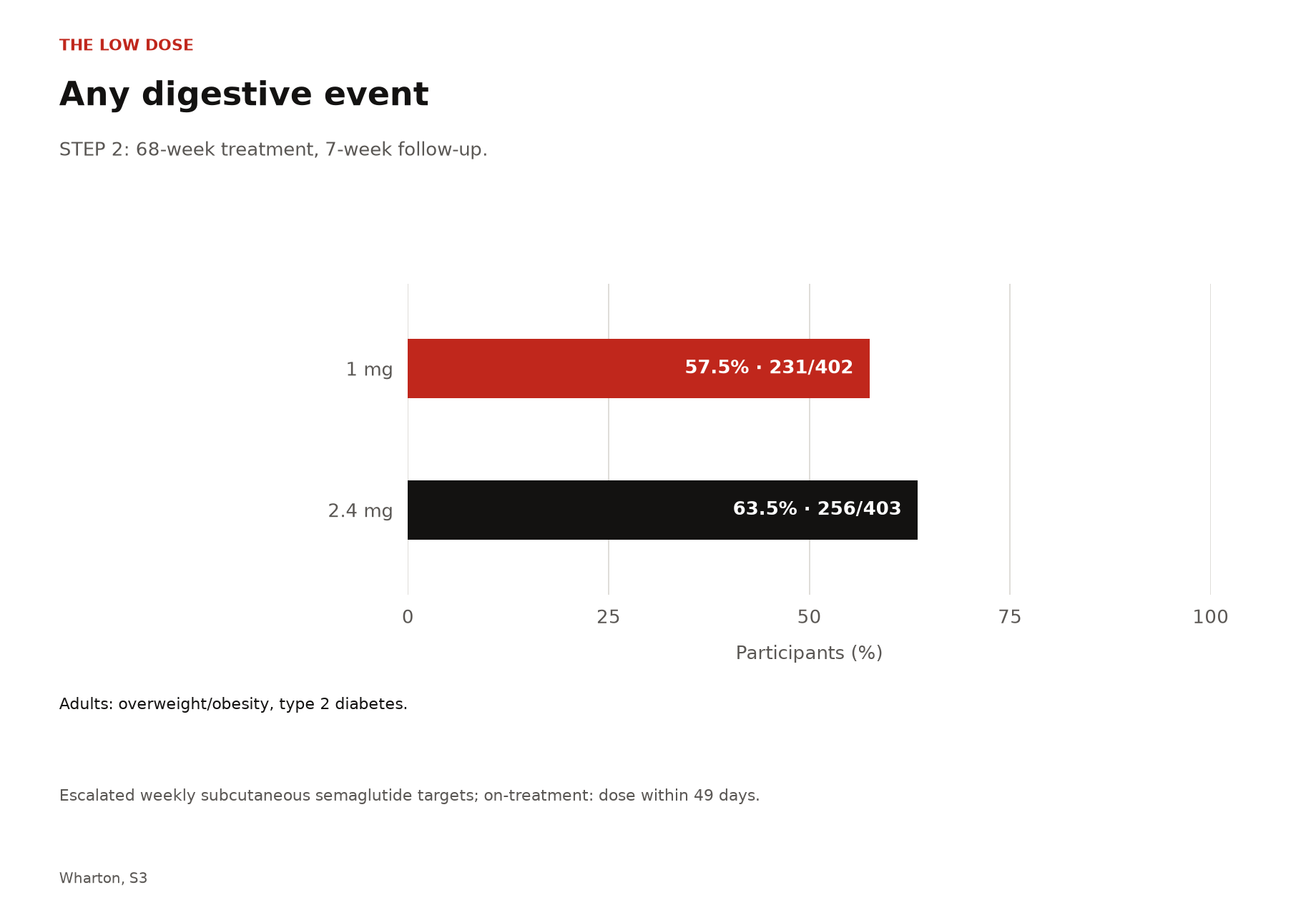
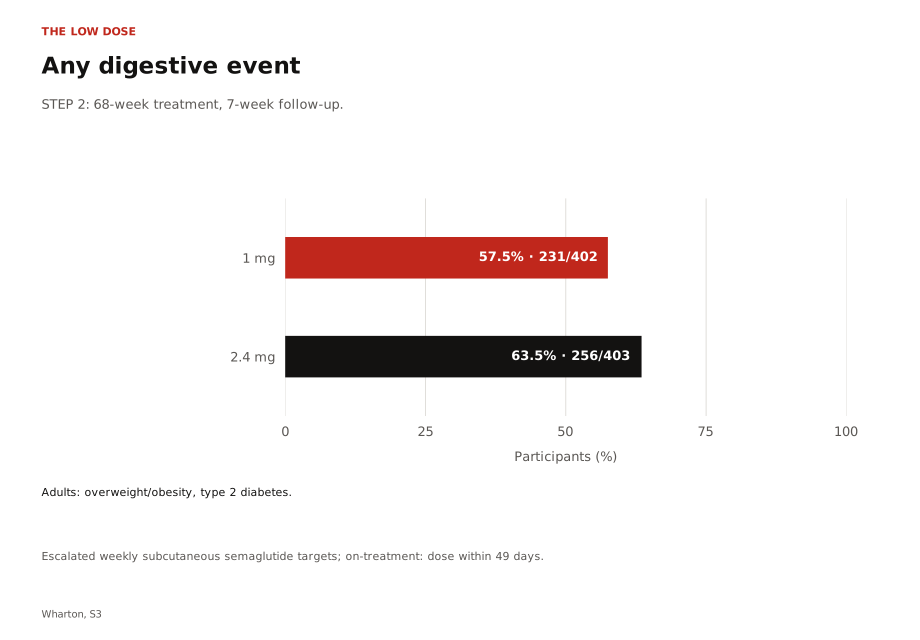
Any digestive event
STEP 2: 68-week treatment, 7-week follow-up.
Adults: overweight/obesity, type 2 diabetes.
Escalated weekly subcutaneous semaglutide targets; on-treatment: dose within 49 days.
Sources: [1]
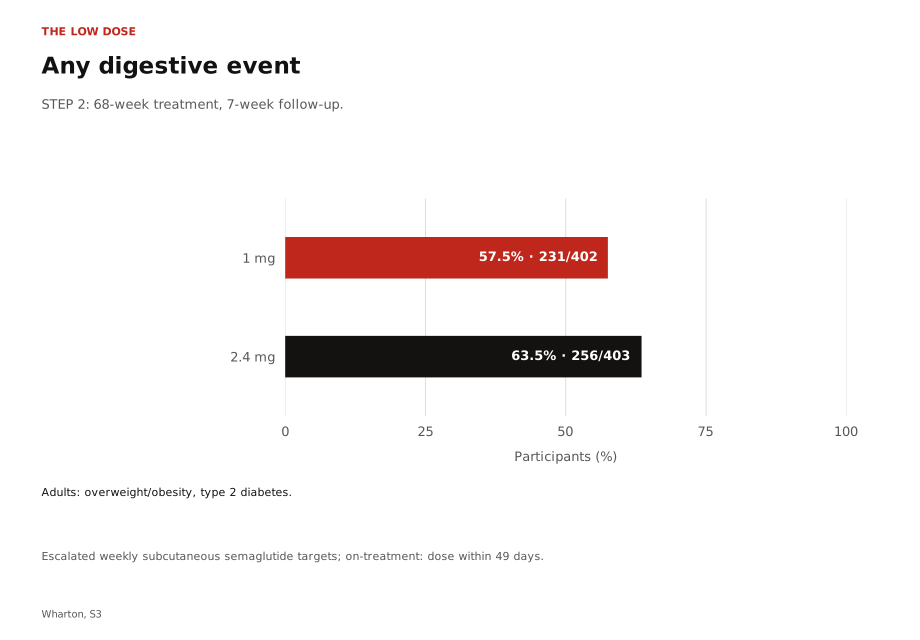
| Target | n/N | Percent |
|---|---|---|
| 1 mg | 231/402 | 57.5% |
| 2.4 mg | 256/403 | 63.5% |
Start with a complete intervention
Post hoc report describes escalation toward assigned targets; Novo Nordisk funded the trials, with three employee-shareholder authors.
A useful way to read this evidence is to write the proposed intervention as a sentence with a beginning, a course and an endpoint. What would be started? Under what rules would it change? What would happen if the plan could not be followed? These questions define the strategy whose consequences one wants to understand. Naming only the final amount leaves the rest unspecified, so different readers could attach different treatment histories to the same label.
This distinction matters even before doing any arithmetic. If a claim concerns remaining at an early stage, that stage has become the continuing strategy rather than one component of another plan. The comparison must then address that changed strategy. Our guide to titration is a separate reading destination for the terminology; it does not supply the missing experiment. The scientific task here is to state the intervention precisely enough that another researcher could recognize whether a proposed comparison actually tests it.
Sources: [1]
A target label is not an exposure diary
An assigned target and the treatment someone actually receives answer different descriptive questions. The first identifies the intended strategy. The second would require a timeline recording what happened. A target label alone cannot tell a reader how long each person spent at each stage, whether there were interruptions, or whether the planned course was completed. That is a limitation of the information encoded in the label, not an allegation about any particular participant.
To compare people according to their eventual exposure would require additional care. Grouping them after treatment has begun could also group them by the reasons their treatment histories diverged. An analysis would need to explain how it handles those reasons before attributing an outcome difference to exposure itself. The original assigned comparison and a later exposure-based comparison should therefore be recognized as different questions, rather than treated as interchangeable labels for the same result.
The practical reading skill is to identify which description a document provides. Our prescription-reading guide offers another place to examine treatment terminology. A prescription document, an intended study regimen and an observed exposure record have different jobs. Substituting one for another creates information that the original document never contained.
Sources: [1]
Extending an early stage changes the question
Consider the proposed change in abstract terms: a stage that would otherwise end is extended. The amount at the beginning might be unchanged, but the duration and later course are now different. The intervention has changed along the time dimension. A scientific justification would need to address that change, rather than rely solely on a match between the amount named in the proposal and an amount appearing elsewhere.
This is not a claim that every such change must produce a different outcome. It is a statement about what would establish similarity. One would need relevant observations or an explicitly justified model connecting the strategies, with outcomes measured over a suitable period. Assuming that a shared component makes whole strategies equivalent skips that connecting step. Conversely, the absence of a matching comparison in a particular figure does not show that the proposed alternative fails.
A useful claim stays specific about what is being extended and what is expected to remain similar. Is the question about the occurrence of symptoms, the ability to continue treatment, or a desired benefit? A comparison adequate for one of those questions may leave another unresolved. Defining them separately makes the proposed evidence test more demanding in a productive way: it becomes possible to say exactly what would support the claim.
Sources: [1]
Write down the comparison that is missing
An omitted strategy needs its own place in the research question. The first step is to describe both alternatives fully, including their rules over time. The next is to choose the outcome and observation period before examining results. Otherwise, a claim can shift between different meanings of success whenever one comparison is inconvenient. The table below is an editorial framework for keeping those choices visible; its rows are proposed questions, not study findings.
A convincing comparison also needs a reason to believe the groups are comparable for the inference being made. Merely locating people who followed different courses would not settle why their outcomes differed. The design and analysis would have to address how the courses were chosen and which other differences might matter. This does not require the reader to invent a correction; it requires recognizing the unresolved issue.
Our tirzepatide regimen analysis approaches a related methodological question from another angle. Reading the analyses together is useful for practicing the distinction between a plotted alternative and a proposed alternative. It does not create a comparison between medicines or establish which treatment a person should receive.
| Proposed change | Evidence needed | Unresolved inference |
|---|---|---|
| Hold an early stage longer | A comparison that specifies both treatment courses | Whether the extended strategy changes the outcome |
| Change the target | Comparable strategies with the intended targets defined | Whether the target difference explains the result |
| Change the observation period | Outcome measurement aligned to the new period | Whether an earlier summary describes later experience |
| Apply the result elsewhere | Evidence connecting the populations and care settings | Whether the original estimate transfers |
Sources: [1]
A whole-period proportion cannot locate a treatment phase
An aggregate outcome compresses a timeline. Once information has been reduced to whether an event occurred during a defined period, the summary cannot reveal every position on that timeline. Dividing an overall proportion by the number of phases would not recover the missing timing. Neither would assigning the entire proportion to the final stage merely because that stage names the group. Those operations would add assumptions rather than extract observations.
A phase-specific question would need an appropriate time origin, a definition of who contributes observations and a rule for handling changes in treatment. A comparison starting at entry and a comparison starting only after reaching a later stage could describe different groups. Before interpreting either, one would need to know how people became eligible for that analysis. Elapsed time and time spent in a particular stage should not be treated as synonymous.
Questions about experience after treatment changes need the same discipline. Our guide to stopping a GLP-1 is a separate resource for that topic. Here the methodological point is narrower: a result belongs to its observation rules. Moving the start or end of the question requires checking the evidence again, rather than assuming the original summary follows the reader into a new period.
Sources: [1]
Preserve the unit that was counted
When a proportion counts people with a qualifying event, each included person contributes according to that counting rule. Recurrent episodes and time spent experiencing symptoms are different quantities. A reader cannot recover them by multiplying the participant proportion by a guessed frequency or duration. The information was not retained in that summary. A more detailed question requires a more detailed measurement.
This also explains why the complement of a proportion has a narrow meaning. Failing to meet the counted criterion is not the same as demonstrating every desirable aspect of health or comfort. Similarly, meeting a criterion does not, on its own, describe the intensity of an experience. The endpoint definition determines which distinction the summary makes; it does not establish all the other distinctions a reader might care about.
The numerator and denominator should therefore be read together with the qualifying rule. Ask who could enter the count, what observation made someone count and which people formed the comparison group. Keeping those elements intact prevents a precise-looking figure from being turned into a different measure. It also helps identify the next useful question: whether the concern is occurrence, recurrence, duration or severity, and what data would distinguish them.
Sources: [1]
Applicability requires a reasoned connection
Transferring a result to a new setting is another comparison problem. A reader needs to identify the population for the intended claim and ask which differences from the studied setting could affect interpretation. Eligibility, treatment delivery and outcome measurement are separate parts of that assessment. A shared medicine name does not complete it. Equally, finding a difference between settings does not prove that the effect must change in a particular direction.
A useful argument for applicability makes its assumptions explicit. It might explain why a difference is unlikely to alter the specific outcome, or identify additional evidence that tests the result in the new setting. Without that reasoning, the conclusion is an assertion of transfer. The strength of the argument should match the claim: a broad promise needs support across more conditions than a carefully limited description.
Product identity and the surrounding treatment plan also belong in this assessment. Our compounding guide is a separate destination for product and policy questions. Linking to it does not establish equivalence between formulations. For scientific interpretation, any proposed bridge between products or routes must be justified rather than supplied by a familiar ingredient name.
Sources: [1]
Tolerability alone cannot settle overall value
Choosing an overall strategy involves more than identifying which summary looks preferable. A tolerability question asks about an experience or event definition; an efficacy question asks about a desired effect. A value judgment then adds priorities and practical constraints. Moving from the first question to the last without measuring the intervening outcomes leaves essential parts of the judgment unstated.
A clear comparison would specify which benefits and burdens matter, how they are measured and whose priorities determine their importance. It would also distinguish an observed group result from a prediction for a particular person. Even a well-described average experience cannot identify in advance every individual outcome. The appropriate response is to define the decision more fully, not to declare an overall winner from one endpoint.
For readers comparing commercial documents, our editorial approach is to keep the evidence question separate from the transaction question. The twelve-month cost guide and Contour Health review are destinations for examining documentary terms. Neither link implies that a seller provides the studied regimen or reproduces its outcomes. A price or contract can describe a purchase; the clinical claim still needs evidence connecting the actual intervention to the intended result.
Sources: [1]
Make a claim precise enough to challenge
A strong claim can be stated in a way that makes contrary evidence recognizable. Instead of saying that a smaller amount is better, specify the complete strategy, the outcome, the comparison and the observation period. Then ask what finding would count against the claim. If no possible result could change the conclusion, the argument is no longer functioning as an empirical test.
The distinction between uncertainty and contradiction is useful here. An unresolved question does not supply a negative result. But uncertainty also does not authorize a positive promise. A reader can keep both points in view by separating what was observed, what is inferred and what remains to be tested. The table offers an original way to organize those categories without assigning invented probabilities to them.
Commercial language deserves the same specificity. Our guide to examining a GLP-1 seller is another reading destination for documentary checks. In this analysis, the scientific question stays focused on whether the evidence addresses the claimed intervention and outcome. A clear document helps identify the claim; it cannot turn an untested inference into a measured result.
| Claim element | Question to ask | What would clarify it |
|---|---|---|
| Intervention | Is the entire treatment strategy specified? | A reproducible description of its course |
| Outcome | What would count as success or harm? | A definition chosen before inspecting results |
| Comparison | Which alternative is being evaluated? | An explicit comparator with aligned measurement |
| Interpretation | Which step goes beyond observation? | A stated assumption and a way to examine it |
Sources: [1]
Keep clinical safety decisions in their own evidence context
Wegovy’s current prescribing information contraindicates use with personal or family medullary thyroid carcinoma, MEN2, or prior serious hypersensitivity to semaglutide or any ingredient. The boxed warning reflects rodent thyroid tumors; relevance to humans remains unknown. Warnings address pancreatitis, gallbladder disease, dehydration-related kidney injury and severe digestive reactions. Severe gastroparesis makes use not recommended. Obtain prompt assessment for severe or persistent abdominal pain; discuss persistent digestive symptoms with a clinician. Tell the anesthesia team about treatment. Graphs cannot prescribe dose changes.
The methodological reason for keeping prescribing information distinct is straightforward: a study comparison and a clinical decision have different responsibilities. A comparison can help answer a defined research question while leaving individual suitability unresolved. A clinician evaluating a person needs relevant clinical information and the appropriate prescribing context. A graph cannot supply that information by becoming more detailed or visually persuasive.
The same separation improves scientific reading. One can assess whether an intervention is well defined, an outcome is correctly counted and a proposed inference is justified without converting that assessment into instructions. The useful endpoint of this analysis is a more precise question to investigate. It is not a self-directed plan for reaching a target, remaining at a stage or changing treatment in response to a plotted proportion.
Questions about the evidence
What makes a regimen different from a dose?
A dose names an amount, while a regimen describes how treatment proceeds. Duration, timing and rules for changes can alter the strategy even when an amount is shared. To assess an evidence claim, define the whole course being proposed. That makes it possible to identify whether a study examines the same intervention or only a component with a familiar label.
Sources: [1]
Does an absent comparison prove that a smaller-dose strategy fails?
No. Absence from a particular comparison leaves that question unresolved. It does not establish failure, success or equivalence. A useful next step is to specify the proposed strategy and the outcome, then identify evidence that actually addresses both. This is a statement about the limits of the comparison being read, not a claim that no relevant research could exist elsewhere.
Sources: [1]
Why not divide a total event proportion across treatment stages?
The overall proportion does not contain the timing information required for that division. A stage-specific analysis would need observations aligned to the stage and a clear rule for who contributes data. Arithmetic cannot reconstruct information that the summary has discarded. Any allocation across stages would therefore require additional evidence or assumptions that should be stated and examined.
Sources: [1]
What evidence would make a comparison more applicable to another setting?
A reasoned connection would identify relevant differences in the population, intervention and measurement process, then examine whether they alter the intended inference. Additional observations in the new setting could help. Applicability is strongest when the connection is explicit; neither a shared product name nor a list of differences alone establishes how a result will transfer.
Sources: [1]
Can a tolerability comparison identify the best overall strategy?
Only if the broader judgment is supported by the other outcomes and priorities it requires. Tolerability does not measure every benefit or burden. An overall assessment needs a defined comparison, relevant outcomes and a clear account of how they are weighed. Keeping those steps visible prevents a narrow result from acquiring a broader meaning simply through confident wording.
Sources: [1]
Editorial assessment
The most useful reading of a dose comparison starts by preserving the intervention it actually represents. Our interpretation is that a proposed smaller-dose strategy should be evaluated as a complete course with a defined comparator, outcome and observation period. Target labels, participant counts and clinical decisions each carry different information. Keeping those distinctions intact allows a reader to ask a specific next question rather than fill a missing comparison with an assumption. It also leaves room for new evidence to change the answer: a clear uncertainty is a research problem that can be investigated, while an undefined promise is difficult to test.
Sources and access
- Wharton (2022): semaglutide tolerability
Article and supplement checked.
Checked .
- Rubino (2025): tirzepatide tolerability
Article and supplement checked.
Checked .
- DailyMed: Wegovy prescribing information
Current official label checked.
Checked .
- DailyMed: Zepbound prescribing information
Current official label checked.
Checked .
Coreage Rx pays us a commission on sign-ups through our links. It does not affect our scores or rankings. How we rate · Disclosure